Forex trading for beginners in 2026 explained through market microstructure and liquidity
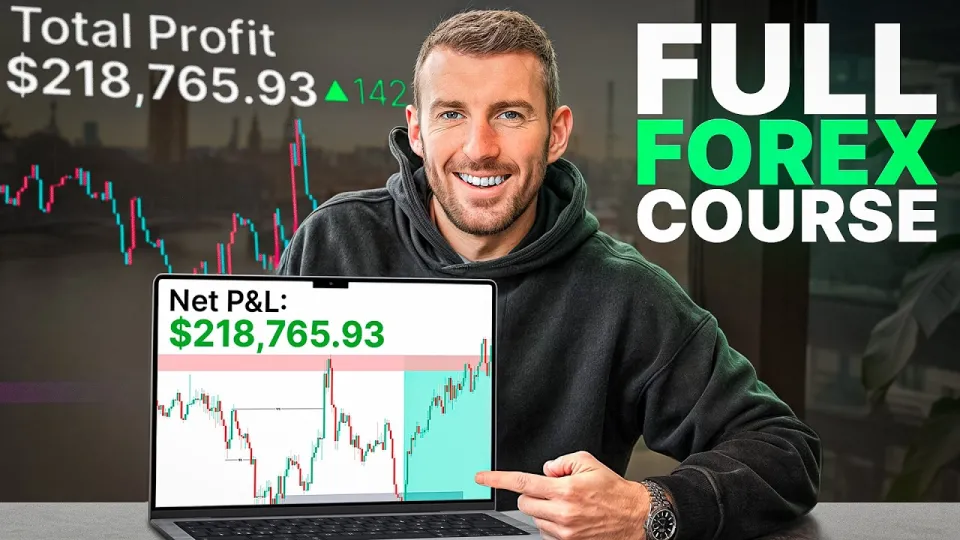
Video: Beginners Guide To Forex Trading In 2026 (+3 hours)
Want articles like this for your own video to promote it on YouTube and Google? Order them through the Telegram bot @sat_sit_bot. It writes articles around your video, embeds the video and publishes them on popular niche websites (no ads). Your first 50 articles are free.
· based on the channel Matt Donlevey - Photon Trading
Forex is the global over-the-counter market where currencies are quoted in pairs, and beginners succeed in it by learning how price actually moves — through order flow, liquidity and market structure — before touching a chart pattern. The practical path is to understand bid, ask and spread, study auction market theory and supply and demand, then build a written trade plan with fixed risk, backtest it and journal every trade. Matt Donlevey's Photon Trading guide, a three-hour beginner course published on the channel, follows exactly that sequence, and the free Photon Trading course plus cheatsheets is available at the Photon Trading free training page.
What forex trading actually is and how the market is structured
Forex trading is the exchange of one currency for another at an agreed price, and the market has no central exchange — banks, brokers, funds and retail traders interact through a decentralised network of liquidity providers. Currency pairs are quoted with a bid (what buyers pay) and an ask (what sellers accept), and the gap between them is the spread, which is the trader's first cost on every position. Matt Donlevey's course opens with this definition before moving into the mechanics, because a beginner who does not understand the spread cannot correctly evaluate a strategy's edge.
The three structural layers a new trader needs to separate are:
- Market microstructure — bid, ask, spread and the order book that records resting buy and sell interest.
- Auction market theory — the idea that price is a continuous auction searching for the level where buyers and sellers agree, and that movement happens when one side runs out of resting orders.
- Order flow — the actual stream of executed trades that pushes price from one liquidity pool to the next.
These three ideas replace the usual beginner toolkit of geometric shapes. A triangle or a head-and-shoulders pattern does not explain why price moved; a cluster of resting orders being consumed does. That distinction is the core argument of the video, and it is the reason the strategy taught later is built on structure and liquidity rather than on indicator crossovers.
Why technical analysis alone fails and what replaces it
Technical analysis gets a poor reputation because most of it describes the shape of price after the fact instead of the reason it moved, and the fix is to study the underlying dynamics first. Candlesticks, trendlines and chart patterns are compressions of order flow, so they only carry meaning when read against the liquidity and structure that produced them. In the course, candlesticks are introduced as a reading tool, not as a signal generator, and the market dynamics section follows immediately to explain what a candle is actually recording.
The practical consequence for a beginner is a different order of study:
- Learn what a candle represents in terms of buying and selling pressure.
- Learn where resting liquidity sits and why price is drawn toward it.
- Learn how structure defines direction before choosing any entry trigger.
- Only then add a strategy, and test it on historical data.
This sequence is slower at the start and much faster later, because a trader who understands the mechanism can adapt when conditions change, while a trader who memorised patterns cannot.
The Photon strategy framework: structure, premium and discount, supply and demand
The Photon strategy is a systematic framework built on market structure, premium and discount pricing, multi-timeframe alignment, supply and demand zones and liquidity concepts. Market structure is the skeleton: higher highs and higher lows define an uptrend, lower highs and lower lows define a downtrend, and a break of that sequence signals a possible shift. The course separates three types of structure so a trader can tell a genuine trend change from a temporary pullback.
Premium and discount pricing adds the location filter. Within any dealing range, the upper half is premium and the lower half is discount, so buying is preferred in discount and selling in premium. Multi-timeframe analysis then decides which range matters: the higher timeframe sets the bias, and the lower timeframe is used only for timing the entry. Supply and demand zones mark the areas where aggressive orders previously overwhelmed resting liquidity, which makes them candidates for the next reaction.
Liquidity concepts complete the picture. Price tends to move toward pools of stop orders and pending orders, because that is where fills are available, so a sweep of a prior high or low followed by a rejection is a common setup. Entries are then taken on the lower timeframe once the higher-timeframe context, the location and the liquidity event all agree.
Money management, trade management and the mistakes that cost beginners most
Money management is the part of the process that decides whether a trader survives long enough to become consistent, and it comes before any entry technique in importance. Position size should be calculated from the distance to the stop loss and a fixed percentage of account equity, so that a losing streak never removes the ability to keep trading. Trade management covers what happens after entry: where the stop sits, whether partial profits are taken, and how the trade is closed if the reason for it disappears.
The three mistakes the course highlights for beginners are consistent across most trading accounts:
- Risking too much per trade, which turns a normal losing streak into an account-ending event.
- Trading without a plan, so decisions are made emotionally in the moment rather than in advance.
- Skipping the journal, which makes it impossible to tell whether a loss came from a bad process or bad luck.
A written trade plan fixes the first two by defining the market, session, setup, risk per trade and exit rules before the market opens. Backtesting then tests whether the plan has an edge on historical data, and the journal records whether the trader followed it.
Choosing a broker, understanding costs and executing a trade
A broker is the intermediary that gives a retail trader access to liquidity, and the choice should be driven by regulation, execution quality and total cost rather than by bonuses. The course covers broker selection and trading costs together because they are the same decision: spread, commission, swap and slippage all reduce the edge of a strategy, and a setup that looks profitable on a raw chart can be unprofitable after costs.
Execution is a mechanical step once the plan exists. The trader defines the entry, the stop and the target, sizes the position, places the order and then records the result. Journaling closes the loop: each trade is logged with the reason for entry, the outcome in risk multiples and a note on whether the plan was followed. Trading psychology is treated as a later stage — the argument is that discipline becomes a real problem only after a strategy with a measurable edge exists, because before that there is nothing to be disciplined about.
Common beginner questions about learning forex
Beginners arriving at a three-hour course usually share the same concerns: whether the material is too dense to absorb, whether free content can replace paid mentorship, and how much capital is needed before starting. The realistic answer is to work through the material in sections, apply one concept at a time on a demo account and only increase risk after a documented sample of trades. Comments on the video show the same pattern — experienced traders use it as a structured refresher, while complete beginners find the pace demanding and prefer to pause and rewatch specific sections.
The other recurring question is whether a funded account or trading other people's money is a shortcut. It is not: prop firm and funded programmes impose drawdown and profit targets that require the same risk discipline, so the process has to be built first. A trader who cannot keep a small account within fixed risk limits will not keep a funded one either.
Useful links
- Free Photon Trading course and cheatsheets: https://www.photontradingfx.com/free-training?el=beginnersguide&htrafficsource=YT
- Photon mentorship programme: https://www.photontradingfx.com?el=beginnersguide&htrafficsource=yt
- Free Telegram channel with analysis and trade recaps: https://t.me/photontrading
- Instagram: https://www.instagram.com/photontrading/
Final takeaway
Forex for beginners is not a search for the perfect indicator but a progression from market mechanics to a tested process. Learn how bid, ask and spread work, why order flow and liquidity move price, and how structure, premium and discount and supply and demand define location. Then write a trade plan, backtest it, control risk per trade and journal the results. The full walkthrough behind this article comes from the channel Matt Donlevey - Photon Trading, whose three-hour beginner guide covers microstructure, the Photon strategy, money management and psychology in one sequence — start with the free Photon Trading course and work through it section by section.
Key takeaways
- Forex is an over-the-counter market of currency pairs priced through bid, ask and spread, not a single exchange.
- Price moves because of order flow and liquidity, so structure and supply-demand zones matter more than chart shapes.
- Matt Donlevey's Photon Trading beginner guide runs over three hours and covers microstructure, SMC concepts, entries, management and psychology.
- A repeatable process means a written trade plan, backtesting, a broker cost check and a trade journal.
- Most beginner losses come from skipping risk rules, not from a lack of indicators.
Questions & answers
How long does it take to learn forex trading as a beginner?
There is no fixed timeline, but a realistic path is several months of study and demo trading before risking real money. The sequence matters more than speed: learn market microstructure, then structure and liquidity, then build and backtest a written plan. A trader who documents a few hundred trades on demo has a far better base than one who rushes to a live account.
Is a free forex course enough, or do I need paid mentorship?
A free course can cover the full framework — mechanics, strategy, risk and psychology — and the Photon Trading guide is an example of that. Paid mentorship mainly adds feedback, accountability and structure. It is worth paying for only after you have worked through free material and know exactly which gap you need to close.
How much money do I need to start trading forex?
Many brokers allow small deposits, but the amount matters less than the risk per trade and the cost drag from spreads. A small account with tight risk control teaches the same lessons as a large one, while an oversized position on a small balance ends the learning process early. Funded account programmes are an alternative once a documented strategy exists.
What is the difference between market structure and supply and demand?
Market structure describes the sequence of highs and lows that defines trend direction and shifts. Supply and demand zones mark specific price areas where aggressive orders previously absorbed resting liquidity. Structure tells you the direction and context, while supply and demand tells you where a reaction is more likely, and the two are used together rather than separately.
Source: Beginners Guide To Forex Trading In 2026 (+3 hours) · Markdown version